Friday, April 24, 2015

Hayatt Walkway Collapse 1981

Kansas City is famous for many things: barbecue, the Nelson Art Gallery, the Royals baseball team, the Kansas City Chiefs, the Country Club Plaza, and Crown Center.  It’s also remembered for not-so pleasant people and events like Tom Pendergast, the Union Station Massacre, mobster Nick Civella, and the Hayatt Walkway Collapse of 1981 when 114 people were killed at that newly opened hotel.  I’m surprised more people don’t remember the tragedy because it made the national and internal news.  Even more surprising is the mystery of how it happened and why, I believe, it was allowed to happen.

I was working in downtown Kansas City at the time.  The day before the collapse a co-worker and I took our lunch break to see this newly constructed marvel, the Hayatt, which was like Crown Center a jewel in KC’s drab concrete and steel skyline.  (Henry Ford did the same urban renewal in Detroit with his version –  the Renaissance Center.)   My recollection is of a first class structure with an interesting tier of catwalks above an expanse used for social gatherings called Friday Night Teas.  It was a place for singles to mix.  What interested me especially were the catwalks because I’d never seen anything like them.  Leonard and I couldn’t help venturing out onto the center one just far enough for it to start swaying with just us two on it.  I remember my exact words, “I’m getting off this thing!”  I felt it could have collapsed with just us two on it.

When one catwalk pancaked on another and sent the whole thing down everyone asked, “How could such a thing happen?” It was a brand new building.  Overcrowding was a factor, yet my maintenance co-workers and I knew more.  Hanging catwalks are like anything else you hang in a building: AC duct work, plumbing pipes, and electrical cables.  There is a threaded suspension rod called Redi-Bolt that receives washers and nuts.  The bolt hangs from a “channel” (similar in function to the one above your overhead garage door) or a steel frame.   Our conclusion was that a cheap nut or washer was used; there are different grades of steel.  I speculated that Fender Washers might have been used to conveniently join bolts to channel.  They are unusually wide, but thin.

Since 1981 catwalks, especially those between buildings, are a standard feature of Kansas City and America’s urban terrain.  They allow down-town shoppers and the big shots to avoid the streets, crime, and homeless encounters.  Similar collapses have not occurred, so architects and builders must have learned something from the terrible event.  To me there is still a mystery.  Others will say, “It was due to all those people who were on it.”  Then why did it sway with just two on it?  More than that, those who built it must have noticed the same thing.  What about the construction crews or the building inspectors?  Weren’t they also shocked enough to say, “I’m getting off this thing!”?

Friday, April 17, 2015

So You Want to Dig Out Your Pond?

Our old pond was put in by Works Projects Administration (WPA) soon after the drought in 1936.  It was free from the Democrat Roosevelt Administration that’s why our family named it the Roosevelt Pond.  The unexpected gift must have been like what the joyful Chinese farmers in the movie The Good Earth felt when Japanese planes bombed their fields – instant ponds.  That’s the only government help we received in the Ozarks and for some reason the pond hasn’t been touched since.  By the time of my retirement, it was reduced to basically a four foot slop pit for deer, snakes, and snapping turtles.   I thought it would be nice to bring it back, but unlike the unusual freebies of politics or war, it’s expensive.   Word of mouth eventually leads to locals with decades of experience with loaders.  Their expertise is important because the usual cost around here in the Ozarks is $110 per hour.  I was warned that 50% of the time, the scooped-out ponds won’t hold.  They know how to "better the odds."

The second picture shows the old pond being drained.  A breach was made by a back hoe on the dam at the point where the water line would be its deepest, not on the spillway where pond curvature makes for more dirt removal.  The loader digs up old posts and a pipe farmers frequently use to stick in the dam a little below the waterline to water their cattle when the pond freezes over.  The government might have required the configuration with a fence to prevent cattle from fouling the water and stomping down the banks.  A pump is used to drain the water.  There were several small fish left in the pond after all those years, but to save them would have meant they might run into the breach – too dangerous to go after.  The Missouri Conservation Department recommends that everything goes which means a complete clean out.  To the right and underneath is an outcropping of huge limestone rocks the size of bathtubs only flatter.  They’re probably the reason the pond never held water.  The hook on the loader pulled them out. 

This picture shows how the water was pushed into the breach on the dam.  They’re working on the pump that had just quit working.  You can see from the grass on the bank that the pond had always been half full.  Gravel is scooped out and put on a slop pile never to be used except for fill around the farm.  It takes about two years for one of these piles to dry out.  What’s left elsewhere was a seam of clay which was used as a pond sealant.  (I’ve heard stories of people using old dry wall)  I doubled pond’s size and had it dug nine feet deep to allow the stocking of large mouth bass.   They can only live in ponds that are at least eight feet deep, otherwise, they’ll cook during the summer.  I lost two pond stockings in another pond finding that out!  Nowadays a laser transit on the spillway is used to measure depth.  It took several hours removing the outcrop and I had barely enough clay to cover the larger pond area which I figured was about 1/3 of an acre.

The end result was a $3200 gamble and the digging out and restoration that took several weeks because of the drying required.  At least I took nothing and made it into something.  September, 2013 was many months ago and the pond leaked until recently.  Last spring I stocked fat head minnows and they’re doing well.  A month ago I put in two grass carp.  They seem to always do well.  The next step, if the pond stills holds, is Blue Gill which are the main food for bass.  By the time they mature and the bass arrive and are big enough for catching, I figure each one will be worth about a $100 apiece.


Monday, April 13, 2015

A Day at the Westport Reporter

How many young men came through the doors of the Westport Reporter from Westport High School and its neighborhood looking for work?  I was one of them during most of the sixties.   Harold Reddoch, the owner, had a steady supply of paperboys and office clerks because Kansas City’s Westport was still stable.  Demographics had yet to change another American city for the worst.  I remember of few names: Randy Becker, Gary Boyle, Ronald Elliott.  The Westport Reporter was called a newspaper although its reach went to just part of Kansas City, Missouri and was a small "advertiser."  Paper routes went from 27th St. on the north to 75th on the south where the old Fairyland Park was.   State Line was its farthest reach on the west although we overlapped at KU Medical Center.  Troost formed the eastern boundary where 1968 race rioters burned down the entire corridor.

My job at seventeen was as an office clerk before and during that summer of 1968.  I operated a Headliner which printed out the product headlines for paste-up work long before Photo Shop and computers.  I also did the Wolferman’s store ad in the picture.  Ron Elliott was the lead paste-up man.  The artwork would be photographed and transformed into an offset printer plate.  Harold purchased one of these presses during my stay and I remember the tickety-tickety noise and smell of the ink vividly.  After the pages came off they would be inserted and joined with others and shuffled in the box type jogging machine like the paint shaker you see at WalMart. 

I remember Harold.  He had a crew cut and smoked a cigar – no nonsense and driven in a tough inner city.  He loved history and once recommended I read Winter War, the story of the Russian- Finnish War of 1940.  I remember Jack Larson, his lead office person when I started there as a paperboy when I was still going to Rollins Elementary.  He had an unusually good sense of humor, tolerated us high school kids, and had an excellent telephone manner with advertisers.  The Westport High kids went off into life like me, but I’m glad at least one of us can recall and write about Westport and the people who lived and worked there.

Tuesday, April 7, 2015

29 Palms: Arrival

Getting off the bus at Camp Wilson in 29 Palms is like going to the kitchen and putting your head into the oven.  It’s that hot.  Immediately my nose shrank due to the lack of humidity.  This is the Mojave Desert where Patton practiced with his tanks before the war.  In many areas, supposedly off limits to everyone, is ordnance sticking out of the sand – some unexploded.  We had arrived from Ontario, California from Kansas City’s Hq. Co. 24th Marines for CAX78.  I remember going down Highway 62 into Yucca Valley aptly named and passing the exotic town of Joshua Tree.  I thought, “How bad could it be?” as we pulled in to the main base.  I’d been stationed at Ft. Hauchuca, Arizona for intelligence training two years before and that wasn’t so bad: There were patches of snow still in the mountains overlooking the desert in February.  There were no school dorms or barracks for us at 29 Palms.  Of course active duty types hate reservists so the Standard Operating Procedure is to immediately bus them to Camp Wilson which at that time was a tent city on the north side of the base.

I’ve recently heard on TV that the highest recorded temperature in the United States was 138 degrees in some desert.  In our tents one afternoon our corpsmen came out and measured the surface temperature (August) at 144 degrees.  It was so hot that a flock of Roadrunners that stumbled into our camp, lined up on the narrow shadow of a telephone pole.  The next photo is what it looks like during a sandstorm.  You hunker down and check the tent ropes.  Our floor was sand.  Nothing was pre-fab.  Cots were wooden because the metal ones always got too hot.  After a week someone hauled in a rubber water bladder for showers and it’s hard taking a shower in a wooden pallet.  Girls were being added to USMC combat units and they always showered first.  There was a lot of volunteering for shower tent guard duty all of a sudden.  Across from our tent was the Colonel’s big water bag hanging on a tripod.  One rebel among us soaked his cover in the sacred object before he starched it (the cover).  We bought our little ones at the Exchange.  They were canvas with a cork stopper and looked like a purse.

The last photo is dawn at 29 Palms shortly before another sand storm coming in from the East.  In the distance are the mountains above the valley where the exercise was going to take place.  Closer are the cement pads supporting water pipes for shaving and washing.   The little white shacks were used for another purpose.  I was always amazed at how long some Marines would stay in them to avoid a work detail (officers too).  The trick is to bring a big cigar.  Note the M-60 tank with its turret turned backwards moving north.  It was part of the positioning up the valleys for that particular battalion’s exercise the next day.  I really mean “all” the unit’s equipment including 155mm SP howitzers, jeeps, trucks, and even Bradleys that were new at the time.  Bradleys had little respect because they were lightly armored and were yet to be proven.  We had Israeli advisers.

Monday, March 30, 2015

The Ozarks During the Depression

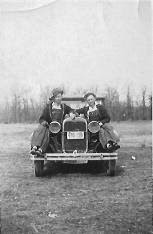
Recession, downturn or depression - it’s what happens when the big shots on Wall Street call in their speculations.  It’s like a high stakes card game, only it’s one played with people’s lives.  Someday it’ll happen to nearly every American except the Wall Street crowd who are the card sharks.  My first recession was in 1971 caused by a national trucking strike.  The Recession of 1982 came next and the most recent occurred with the Sub Prime Crash of 2008.  Ozark boys went through the same thing in the 1930s only it was more severe, but they were young, hardworking, and resilient because they followed the harvests of the Great Plains where the work was.  Dad and his best friend, Mott Davis, are shown packed up and ready to leave in a photo taken on our place during the Depression.   Key overalls, a good suitcase, and a jug possibly filled with an adult beverage are all you needed.  The car is a Model A.

John Steinbeck and his Grapes of Wrath got all the attention.  Okies lost their farms and fled to California.  Grandma Joad died along the way and “We’re the people” Ma Joad held the family together.  When they reached the Land of Milk and Honey, they picked fruit.  Our family planted corn and picked it for farmers hurting for labor near Sioux Falls.  (One photo was stamped “Luvern, Minn.”).  After WWII many from the Ozarks went to the Great Lakes (Michigan) where the industrial might of America took off.  In 1936 Missouri had its drought but it wasn’t as serious as the “Dust Bowl” further west in Oklahoma.  Ma always said if it wasn’t for turnips, people here in West Plains would have starved to death.  More on Michigan in Journal of the Silent Majority.


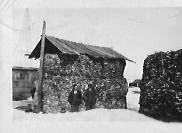
Mott Davis and Henry Cherry (right) are shown in a field of snow.  Henry was partial to what I call “depression caps” popular at the time.  Others form a road crew shoveling near major power lines.  Boys from West Plains, Missouri had never seen snow like that.  Notice one farm’s substitute for a corn silo.  Woven fence wire holds thousands of ears of corn in three layers.  Old plank lumber forms the roof supported by old telephone poles connected by a ridge pole like a tent.  I also have a picture of Dad with a team of huge draft horses that pulled corn wagons. It’s another interesting story worthy of a dedicated posting some other time.  He loved animals and earned the nick name “Doc Cherry.”

Friday, March 20, 2015

WWII Oran: More Clues

In Intelligence School we used to call this Photo Interpretation.  The photo of Dad’s driver and guard is possibly my most valuable clue as to what unit he was with early in WWII.  It took me a long time to realize what bumper markings were – much less what they meant.  As you look at the front of the truck from left to right is the unit hierarchy sometimes down to the truck number in the platoon on the far right.  MBS, the Mediterranean Base Section of Services of Supply appears to be the parent command.  “2 SV?” I believe stands for 2nd Bn Services Command.  (There’s probably a “C” after V.)  The Black driver is a good clue.  Necessity drove integration long before it became policy.  On the back of the photo is its identification: “My driver and gard (sic) in Oran”.  By that time Dad had been promoted from “T” to SSgt and truck platoon sergeant. Whether or not he was training an all-black Transportation Corps truck platoon (16 trucks) is questionable.  The online The Employment of Negro Troops was no help.

The second photo shows Dad in his summer Khakis and tie as a Technical Sergeant posing in one of Oran’s many truck loading sheds.  The “T” usually meant the GI was a technical specialist such as a mechanic, someone not yet in command of others.  In the background is an Army forklift – one of just ten at the port if I remember correctly and an unusually low number for the requirements of Operation Torch.  Note the triangular span of wooden gables under the shed’s ridge.  Judging from the shadows, the sheds are on an east-west axis.  When Services of Supply (Signal Corps, Engineers, Quartermaster, Ordnance, Medical, Chemical, Transportation Corps) landed at Mers El Kibir six miles away on November 11, 1942, Oran was beginning to get wet and cold.  I speculate his wearing of his summer service uniform might have been unavoidably late.  Just eight weeks before he’d been on the RMS Queen Mary with a large contingent of B-17 ground crews coming to England.  I’m still working on the “units aboard” puzzle.

Operations in Africa are overlooked.  All you see on TV is Pearl Harbor, the Battle of the Bulge, and D-Day.  There was dive bombing in Oran and ships blown up at sea off the coast like the Arthur Middleton which I believe Dad saw blown up on January 1, 1943 and night convoys to the east to capture Bizerte and evacuate Tunis where 250,000 Africa Corps Germans surrendered.  I think he was involved in that too.  Germans marched all night beside his resting drivers and trucks. There were bodies floating in Oran harbor when SOS arrived.  Ordnance men removed them.   Isn’t there anything out there besides Lee Marvin and the Big Red One?  The stories of the average GI are more interesting to me, especially when there’s a puzzle involved and it’s personal and some of those pieces are rare.

Thursday, March 12, 2015

Spring Update

We dodged the heavy snowfalls that made a mess of the Southeast.  Rain is on the way and hopefully our Ozark ponds will soon be overrunning.  I saw my first robin and bluebird yesterday.  The sun occasionally breaks through; I'm tired of the gloom of February and this time of year.  If I had a bucket list I'd like to visit more places where the sun isn't hidden so much.  Winter's hay is almost gone.
 
Cable television gets boring too except for Wheeler Dealers which had its last seasons' show last night.  O'Reiley will probably talk about Ferguson tonight which is more interesting than talking without end about Hillary's E-mails.  I enjoy watching the Five, but what happened to Bob?  Has he been replaced?  Fox is right about their leftist competitors:  people get tired of being lectured.  Note to them:  "School's out!" We're free to watch what we want to.
 
I watched Rick Steve's European exploits the other day on PBS.  Does he actually get paid to have that much fun?  If I had a Bucket List I'd fill it up fast with some of his destinations like Berlin and Italy. I've written all this without glasses believe it or not, so I must be getting better.  I'm thinking about future blog posts with less politics, but WWII still has my personal interest.  I can't help it, I'm a Baby Boomer.