Monday, March 30, 2015

The Ozarks During the Depression

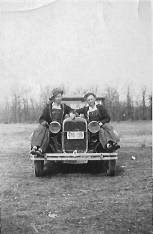
Recession, downturn or depression - it’s what happens when the big shots on Wall Street call in their speculations.  It’s like a high stakes card game, only it’s one played with people’s lives.  Someday it’ll happen to nearly every American except the Wall Street crowd who are the card sharks.  My first recession was in 1971 caused by a national trucking strike.  The Recession of 1982 came next and the most recent occurred with the Sub Prime Crash of 2008.  Ozark boys went through the same thing in the 1930s only it was more severe, but they were young, hardworking, and resilient because they followed the harvests of the Great Plains where the work was.  Dad and his best friend, Mott Davis, are shown packed up and ready to leave in a photo taken on our place during the Depression.   Key overalls, a good suitcase, and a jug possibly filled with an adult beverage are all you needed.  The car is a Model A.

John Steinbeck and his Grapes of Wrath got all the attention.  Okies lost their farms and fled to California.  Grandma Joad died along the way and “We’re the people” Ma Joad held the family together.  When they reached the Land of Milk and Honey, they picked fruit.  Our family planted corn and picked it for farmers hurting for labor near Sioux Falls.  (One photo was stamped “Luvern, Minn.”).  After WWII many from the Ozarks went to the Great Lakes (Michigan) where the industrial might of America took off.  In 1936 Missouri had its drought but it wasn’t as serious as the “Dust Bowl” further west in Oklahoma.  Ma always said if it wasn’t for turnips, people here in West Plains would have starved to death.  More on Michigan in Journal of the Silent Majority.


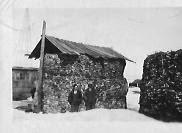
Mott Davis and Henry Cherry (right) are shown in a field of snow.  Henry was partial to what I call “depression caps” popular at the time.  Others form a road crew shoveling near major power lines.  Boys from West Plains, Missouri had never seen snow like that.  Notice one farm’s substitute for a corn silo.  Woven fence wire holds thousands of ears of corn in three layers.  Old plank lumber forms the roof supported by old telephone poles connected by a ridge pole like a tent.  I also have a picture of Dad with a team of huge draft horses that pulled corn wagons. It’s another interesting story worthy of a dedicated posting some other time.  He loved animals and earned the nick name “Doc Cherry.”

Friday, March 20, 2015

WWII Oran: More Clues

In Intelligence School we used to call this Photo Interpretation.  The photo of Dad’s driver and guard is possibly my most valuable clue as to what unit he was with early in WWII.  It took me a long time to realize what bumper markings were – much less what they meant.  As you look at the front of the truck from left to right is the unit hierarchy sometimes down to the truck number in the platoon on the far right.  MBS, the Mediterranean Base Section of Services of Supply appears to be the parent command.  “2 SV?” I believe stands for 2nd Bn Services Command.  (There’s probably a “C” after V.)  The Black driver is a good clue.  Necessity drove integration long before it became policy.  On the back of the photo is its identification: “My driver and gard (sic) in Oran”.  By that time Dad had been promoted from “T” to SSgt and truck platoon sergeant. Whether or not he was training an all-black Transportation Corps truck platoon (16 trucks) is questionable.  The online The Employment of Negro Troops was no help.

The second photo shows Dad in his summer Khakis and tie as a Technical Sergeant posing in one of Oran’s many truck loading sheds.  The “T” usually meant the GI was a technical specialist such as a mechanic, someone not yet in command of others.  In the background is an Army forklift – one of just ten at the port if I remember correctly and an unusually low number for the requirements of Operation Torch.  Note the triangular span of wooden gables under the shed’s ridge.  Judging from the shadows, the sheds are on an east-west axis.  When Services of Supply (Signal Corps, Engineers, Quartermaster, Ordnance, Medical, Chemical, Transportation Corps) landed at Mers El Kibir six miles away on November 11, 1942, Oran was beginning to get wet and cold.  I speculate his wearing of his summer service uniform might have been unavoidably late.  Just eight weeks before he’d been on the RMS Queen Mary with a large contingent of B-17 ground crews coming to England.  I’m still working on the “units aboard” puzzle.

Operations in Africa are overlooked.  All you see on TV is Pearl Harbor, the Battle of the Bulge, and D-Day.  There was dive bombing in Oran and ships blown up at sea off the coast like the Arthur Middleton which I believe Dad saw blown up on January 1, 1943 and night convoys to the east to capture Bizerte and evacuate Tunis where 250,000 Africa Corps Germans surrendered.  I think he was involved in that too.  Germans marched all night beside his resting drivers and trucks. There were bodies floating in Oran harbor when SOS arrived.  Ordnance men removed them.   Isn’t there anything out there besides Lee Marvin and the Big Red One?  The stories of the average GI are more interesting to me, especially when there’s a puzzle involved and it’s personal and some of those pieces are rare.

Thursday, March 12, 2015

Spring Update

We dodged the heavy snowfalls that made a mess of the Southeast.  Rain is on the way and hopefully our Ozark ponds will soon be overrunning.  I saw my first robin and bluebird yesterday.  The sun occasionally breaks through; I'm tired of the gloom of February and this time of year.  If I had a bucket list I'd like to visit more places where the sun isn't hidden so much.  Winter's hay is almost gone.
 
Cable television gets boring too except for Wheeler Dealers which had its last seasons' show last night.  O'Reiley will probably talk about Ferguson tonight which is more interesting than talking without end about Hillary's E-mails.  I enjoy watching the Five, but what happened to Bob?  Has he been replaced?  Fox is right about their leftist competitors:  people get tired of being lectured.  Note to them:  "School's out!" We're free to watch what we want to.
 
I watched Rick Steve's European exploits the other day on PBS.  Does he actually get paid to have that much fun?  If I had a Bucket List I'd fill it up fast with some of his destinations like Berlin and Italy. I've written all this without glasses believe it or not, so I must be getting better.  I'm thinking about future blog posts with less politics, but WWII still has my personal interest.  I can't help it, I'm a Baby Boomer. 


Friday, February 13, 2015

Recovering

Glad to be back.  Eye surgery was tough and disorienting.  I'm back at the library with transitional glasses you can get a the local pharmacy or Walmart.  The next three weeks are the critical time.  

Other than that, I'm dong OK, except mu spelling is a little off.  I watch FOX News and avoid the blood and guts stuff that's upsetting.  As a retiree I avoid the View.  It's so far out that I have to use the clicker as fast as I can reach it.  I watched Wheel of Fortune for the first time is years.  They're in Hawaii now; I guess on a sort of vacation.  Vanna is looking good as usual.  Buying Alaska is fun to look at, but who wants to sit in an unheated outhouse; been there done that.

I appreciate those of you who follow my blog although it's politically incorrect.  Perhaps I will be allowed to keep on posting my speculations, opinions, and observations for several more years.  I haven't listened to Michael Savage since my surgery, but when I feel better, I'll give him another try.

I'm thrilled that these temporary glasses work.  All kinds of things go through our mind when our eyes are affected.  


Friday, January 30, 2015

Eye Surgery

Usually I write about five posts per month.  This month I've been occupied with just seeing the keyboard.  Cataract surgery dampens my production, but I hope it goes well because I love to read and write.  I have to admit surgery is unnerving and scary.  Take needles for instance.  I don't like them.  I've never liked them.  Having good vision is one of God's best blessings.   Baby Boomers know what I'm talking about because we're getting older and millions of us have retired or are beginning to retire or worse.  Ailments are part of being a senior citizen and I admire those little old ladies in pre-op who take it better than me. 

As a kid I remember reading The Oregon Trail by Francis Parkman.  It was right up there with Thirty Seconds Over Tokyo and Drums Along the Mohawk.  Parkman's vision failed him too and eventually he had to rig a jig using wires that kept his pen on the lines of the paper he was using.  At least in my case my ebook made it to Barnes and Noble and Amazon in time.   My hope was to have ebooks stimulate printed sales for better distribution.  I took a chance and it's only $2.99 for millions of tech savy youngsters on a budget.  Journal of the Silent Majority is just my observation on what's happened to America since WWII.  Surely there will be others.  I'd like to be able to read them too.

Hopefully, sometime in late February my eyes will have gotten better so that I may reassume my politically incorrect effort to tell people about a history they're not supposed to know.


Thursday, January 22, 2015

Scrambled Eggs, Smoke, and Geronimo

Before we boarded the ship, part of the orientation to the Little Creek Amphibious Base was a visit to the Navy’s huge indoor Amphibious Warfare Demonstrator.  It was a modeler’s delight complete with all kinds of ships, vehicles, and planes showing how an assault is made.  Each step in the process is lit up for the hundreds of Marines in the bleachers who were lucky enough in their careers to see such a sight.  I remember the beach area where Navy Underwater Demolitions Teams were sent in to scout the landing beaches.  Bridges blow up in softening up bombardments.  A Phantom jet is hit and the parachute pops out. Unfortunately these types of models and demonstrations appear to be a thing of the past.

Soon after we staged our field packs and rifles on the deck of LPD-20, the Navy wasted no time in giving us tips on making our visit a pleasant one.  I remember one well.  It was their concern that we should not go hungry; obviously, they were all well fed.  Their advice for us was to eat a large and hearty breakfast (especially scrambled eggs) the morning of the landing.  My warning to the others went unheeded.     

In the darkness the well deck was jammed with Marines fiddling with their field gear and rifles waiting to load into the rear hatches of the Amtraks.  The lucky ones were the officers who got to ride on top with the Navy drivers and the radio men.  Captain Harris was on top.  I was one of the 25 unlucky ones who were crammed below.  There was loud chatter as we sat on our starboard and port benches.  One guy from Admin was joking and couldn’t shut up.  I had my own thoughts: deafening noise, smelly with diesel smoke, hot, and too crowded.  I was surprised that the deck was made of wood and not asphalt.  This was exciting and I hadn’t done this type of landing before.  At least I didn’t have to carry a safe. The light at the end of the tunnel before us was the Atlantic Ocean coming in fast as the ship’s stern sank.  We were among the last to go and as the Amtrak clanked down the well deck most of us thought of yesterday’s briefing.   Theory was when the Amtrak drops off, it sinks and we bob back up. The last word I heard from the Admin guy (or anyone else) was a loud “Geronimo!”

When the Amtrak bobbed back up, the driver opened the top hatch.  I remember vividly the diesel smoke pouring in and the field radio chatter being drowned out by the loud engines.  I also remember when the first guy got sea sick and started throwing up causing a chain reaction among us who were packed in like sardines.  I purposely had been the last to board the Amtrak so I could be next to the rear hatch to be the first one off when we hit the beach 20 minutes later.  We did not know that the Navy had dumped us nine miles from shore and we drifted south, way off from our landing area.  As the craft lurched upward with each swell, the scrambled eggs and sea water from 24 other Marines cascaded back towards me and splashed on the hatch where I rested my head.  It was like being sick in a tumbler washing machine.  An hour later we finally hit the beach, not exactly like in the movies.  It was more like the scene in War of the Worlds with Tom Cruise when the Tripod crashes to the ground and its canopy opens up with a gentle “swoosh” and all the goop (and smoke) washes out, only the goop was us.  I bet the Navy got a chuckle out of this one.

Friday, January 16, 2015

Little Creek, Va.

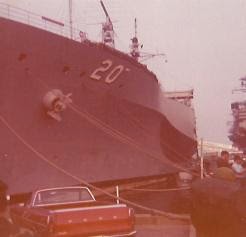
Norfolk Naval Base is the biggest in the world.  Hq, Co. 24th Marines, my old reserve unit, spent two weeks at its Little Creek Amphibious Base in August, 1977.  Its mission this time was to make a landing from the Atlantic.  The first week had the usual training: gas chamber, S-2 briefings, and climbing between the tops of telephone poles on the obstacle course with cargo nets when it was 97 degrees.  We saw our first Harrier jet when it landed in front of our bleachers.  It makes a tremendous noise.  Recon units seem to spend a lot of time dangling on ropes from helicopters making runs across the waterfront.  I took a picture of the aircraft carrier USS Kennedy docked there as we boarded an amphibious ship.  People back on the block have no idea how enormous carriers are.
Water survival was off Little Creek Park in a rubber raft, in uniform of course.  Being from the Midwest, I naturally worried about sharks, but it fades when the instructor dumps everyone overboard and overturns the raft.  The immediate concern is getting the most agile fellow on top, grabbing the ropes and leaning back until he flips it upright.  It amazing how hot it can get in a rubber life raft.  On board our LPD, SSgt. Grimes is modeling a Kapok, the Navy’s old version of a life jacket.  Notice he still wears the old green utilities just now in 1977 being replaced by camouflage.  It was interesting how little interaction there was between us Marines and the “Squids”.   They looked like teenagers.  I guess it’s because we were reservists and Hq. Co. was packed with returning Vietnam veterans. 


Behind SSgt. Grimes is LPD-23, the USS Anchorage, one of many that are the meat and potatoes ships of every Marine Corps landing.  It’s a special type of troopship with a helicopter or Harrier flight deck and a well deck below that floods to discharge landing craft we called Amtracks.  LPDs apparently don’t have any life boats.  I didn’t see any. What happens if one is torpedoed?  Our LPD-20, the USS Green Bay, which was anchored next to the USS Kennedy, is preparing for the landing which was to take place during our second week at Little Creek. (note: Greenbay and Anchorage and their numbers were passed on to their replacements.  I believe the identifications are correct, but I could be wrong). 

I took the last photo from a Mike Boat as we floated around Norfolk Harbor.  Notice the antiaircraft guns on the ship’s port side and the old fashioned ramp.  I never saw an old Mike Boat again.  Hover Craft replaced them.  As for Norfolk Harbor and before I forget, it’s where the Cherry family came to America as indentured servants from England in 1635, but I did not know it at the time.