Friday, October 10, 2014

MOPP Level 4

From our first day we all knew we’d be put in the gas chamber.  At Camp Telega, which is part of the larger USMC Camp Pendleton, our DIs burned CS tablets on a table to saturate the Quonset hut like a smoke house on a farm.  With a blanket covering the door and an occasional shaft of light filtering in, the gathering looked like one of those old 1930s Chinese opium den scenes from the movies.  Over the years the Marine Corps ditched the tablets and went to gas cylinders in modern brick or concrete chambers like the ones at Camp Lejeune where my picture was taken.  Apparently, many of us had figured out that if we waited for the tablets to burn off, the potency of CS gas would too.  So they modernized and gave everyone an equal dose.

Like their active duty counterparts, reservists can’t escape the nasty and uncomfortable training.  I guess it has to be because gas is serious stuff.  It’ll make a believer out of you – nowhere to run or hide.  You can’t breathe and begin to slobber.  All you can do is rely on your raining and use the gas mask and clothing as it was intended.  When the picture was taken the temperature was in the lower 90s and I was sweating profusely.  The woolen shirt was full of sand and the smell of CS gas from the last guy who had recently worn it.  Underneath the shirt is a layer of charcoal to absorb the gas like the face mask does.  When the filters eventually go, that’s it.

When I transferred to the Seabees after Desert Storm in 1992, Nuclear, Biological, and Chemical warfare training intensified.  In our combat training cycle, we dealt with MOPP levels which are stages of donning clothing and equipment: gas masks with hoods, rubber gloves, rubber boots, and woolen trousers with charcoal.  MOPP Level 1 is where you put on the basics.   Subsequent levels stop at MOPP 4 – the full complement.  By 1997 at Camp Hunter Ligget in California Pepper Gas was mixed in with CS Gas.  The valley was alive with Navy and Marine Corps umpires setting off gas bombs that it looked like fog and the big shots called so many MOPP Level alarms that many of us uttered a few “expletives deleted” and kept ourselves at Level 4.

Being retired, it’s hard for me to know what our Armed Forces go through now. Surely NBC training includes Biological and nuclear, especially after 911 and the anthrax scare.  George W. Bush (by fraud) warned us of the “mushroom cloud” in Iraq.  I suppose there will be a whole new cottage industry now that Ebola has come to America.  Survivalists will update their caches and people will flock to the gun shows to buy old gas masks and equipment.  Clorox and charcoal will fly off the shelves.  With the relentless spiral of threats, the American public seems to be poised for its own MOPP level training.

Wednesday, October 8, 2014

Stop the Coming Civil War


Yesterday, Tuesday, October 7th, was the maiden voyage of Michael Savage’s newest book, Stop the Coming Civil War.  Last night on Savage Nation callers gave updates on what they encountered at the bookstores.  Some said the book was given low priority at Barnes and Noble by not having it out front on the New Releases table.  Others said the placement was fine and sales appeared good.  Savage’s credentials that span many decades suggest this one will be a sellout.  He’s has a PhD in epidemiology and is not afraid to criticize open border policies that bring diseases into the U.S. from Central America or Africa.  I’m looking forward to tonight’s The Michael Savage Show.

Savage has always been the misfit like so many of us who aren’t politically correct.  He distrusts the Democrats and Republicans like I do and laments America’s moral and cultural slide which appears to have warped into an avalanche.  I try to catch his show every night now that Jay Leno has been booted off the air at 10:30 P.M. and has been replaced by the silly antics of a younger tech-savvy and uninformed generation that does not read books and cannot anticipate the future because they don’t know the past.  I’m struck by how much I agree with Savage.  He’s angry about our open borders, black racism, the Ebola spread into America, and most of all, with President Obama.  He consoles us by saying we are not alone. 

Michael Savage is more optimistic than I am.  After all, the title of the book is Stop the Coming Civil War and not The Coming Civil War.  Maybe it’s a political calculation, but there are millions of Americans who gave up on the political process many years ago.  In my own book, Journal of the Silent Majority I explain why.  They are the ones who the Media (singular) thinks are interested in the upcoming November elections.  Who cares?  It’s the same bunch of gangsters with the same Sugar Daddy – the same Media that creates the politicians, nourishes the Left, and tabulates the vote.  Until I read his book, I’ll give Savage the benefit of a doubt.  Right now from my humble perspective of a lifetime, I think he’s underestimated how mad real Americans are.  Things in America have to get worse before they get better.  Histories like Thomas Carlyle's French Revolution recorded how the French were asleep and finally with one shout, they were awake.


Monday, September 29, 2014

Shut the White House Down!

Events have driven the Continuity of Government concept further underground.  911 proved that.  There are vast secretive complexes Americans hear little about, unlike the ultimate NORAD facility in Colorado. They’re prime time regulars of America’s television and motion picture scene.  Bunkers underneath the White House remind me of those constructed under Hitler’s Reich Chancellery in Berlin only with better ventilation.  And Hollywood is quick to exploit the reality - the latest movie being White House Down. (Is there really a Marilyn Monroe secret passageway?)  The White House has come a long way from being Andrew Jackson’s populist inaugural destination to being the venerated and pseudo-protected symbol of the Presidency and America.

In more innocent times I saw the White House without its concrete barricades and steel posts which are most likely the product of Timothy McVeigh’s truck bombing of the Murrah Building in Oklahoma.  You could still drive past it on Pennsylvania Avenue and drive they did.  Striking truckers and their noisy trucks encircled the White House when I was there.  Protesters were always picketing in front, shouting, and acting crazy.  My first impression in seeing all this was an uncomfortable realization of the vulnerability of any President.  They were too close to him and his residence.  When I was there in 1975 I took President Ford’s picture about 30 feet away with my Instamatic and carried a backpack and I wasn’t searched!  Update: A man flies his private plane into the White House; An assailant machine guns the exterior of the White House; Two party crashers infiltrate White House social gatherings.  What’s next, Flash Mobs or rioters attacking and looting the White House?  After all, when you riot, you get things and no one gets arrested.

The Roman emperor Tiberius had his Isle of Capri and Nixon and had his Camp David.  (Much to the disappointment of rabid Nixon-haters, he didn’t throw his political opponents over the cliff like Tiberius did.)  Presidents already have their alternative White Houses and why should one residency evolve into a shrine and magnet for terrorists who have graduated from knives, pistols, and rifles to RPGs and bomb vests?  I say make the White House the Presidential Museum staffed by D.C. park rangers like the Truman Home in Independence, Missouri.  Our Continuity of Government plans should reflect reality. If Islamist terrorists can blow up skyscrapers they or other terrorists can level a two-story building.  Shutting down the White House as an official residence of the President is not only prudent, but inevitable.

Friday, September 19, 2014

Birthday in Arizona

Fridays are when the entire base or most of it gets outta town.  I remember seeing one officer pushing a PX cart filled with vodka bottles.  Ft. Hauchuca’s more adventurous types head for Tucson’s motels.  If a guy had a car, he had it made – literally.  SSgt. Fleming, another Marine, had a 1975 Nova SS and never wanted for female companionship.  Not believing in that lifestyle, I spent most of my free time in Special Services, an Army recreational facility that had sports equipment and even music listening rooms.  It’s a pleasant alternative to the smoke hazed Enlisted Club where you go to shoot pool and get drunk.  I discovered the sound track to the movie American Graffiti and became hooked on Doo Wop ever since.  Remember Maybe Baby by Buddy Holly and the Crickets, Little Darling, Since I Don’t Have You by the Skyliners, and Step by Step by the Crests?  Decompression from basic training at MCRD was also accompanied by retiring my Marine Corps birth control glasses and having my ID photo taken on my 27th birthday.

Ft. Hauchuca is a big place, but getting to classes wasn’t that difficult.  Should I call it a tradition, custom or understanding that hitch hiking to class was the norm?  You just jumped in the back of a truck and that was that.  Class could be anywhere: in the field, building or in a vehicle park (familiarity).  Divisional Mini-Kills held outdoors simulated a CP tent situation and were designed to test what the students had learned by “tasking” various intelligence gathering resources.  I made the mistake twice of sending spotter planes below the clouds.  Map reading was critical and the night compass marches proved to me that you shouldn’t march at night.  Seriously, the map reading part was intense: Zulu, minutes and seconds conversions, azimuth (directions).  Order of Battle was more complicated than an NFL game plan.  I also learned the importance of Errata and red collar tabs, but that was then.  With computers intelligence is a different world.

I graduated in April, 1976 in the lower third of my class in the 85 percentile on a curve.  I could never figure it out.  That meant two-thirds of my class graduated above 85%.  My Achilles’ heel at the time was a poor showing in relationships (spying).  Although Intelligence Analyst on the division level was a tactical course with an introduction to Photo Interpretation, Counter Intelligence, and Order of Battle, it also included Sherlock Holmes-type situations involving intrigue.  In part, who slept with whom? The ladies were the best at solving these problems. 

You’ll never know what integration is until you’ve had black roommates. Ft. Hauchuca had a housing problem with surplus officer dorms and not enough rooms for the Enlisted.  I moved into one of them while classes were forming.  There were four people to a room.  Eventually my room was filled with another white guy and two blacks, one of which was a “casual.” It was an explosive situation and a clash of cultures because it was unsupervised – no barracks with Officers of the Deck to enforce rules.  I could never get any sleep because the two blacks always came in late and played their horrible music all night.  You couldn’t run and you couldn’t fight.  That meant automatic jail time.  It could also mean a knife in the night.  There was another troublemaker across the hall that went on for days disturbing the peace until vigilantes beat him up.  After I shipped out to Kansas City the next day after graduation, I heard from the taxi’s radio, a broadcast that someone had been shot to death in the same officer dorms at Hauchuca.  I assumed it was the troublemaker getting his revenge.  I was glad to get home.

Saturday, September 13, 2014

Wheeler Dealers: 5 Star TV


Mike Brewer, the British guy who owned a car dealership for 30 years started Wheeler Dealers many years ago.  I was surprised because the show looks contemporary.  American television is just now seeing its share of auto customizing and refurbishing shows, but Brewer’s show not only has class, but offers viewers an entertaining account of how to restore used cars for a quick sale.  Brewer is affable and loves what he’s doing especially test driving some European make we Americans have never heard of.  Above all, he loves profit and the more he buys low and sells high, the more money he earns.  One of his biggest assets is his side-kick, Edd China, the tree-top fabricator and expert mechanic.  It’s fun to watch this talented genius work in his rubber gloves and call fenders “wings” and hoods, “bonnets.”

In the pragmatic sense Brewer is the King Rat of aftermarket (used) car parts which he and Edd use to fix up old cars for resale.  His dealership experience has rewarded him with a broad network of European parts suppliers and automotive specialists, not to mention pools of buyer contacts in Britain and the Continent.  He even knows the military vehicle market.  Did you see him driving the T-34 tank in Poland?  He is a master of the 1-2-3 negotiation: “How much are you asking?” “What’s your bottom price?” “Meet me in the middle.”  He uses common sense.  For example, every episode presents the condition problem.  Brewer avoids rust bucket cars and those with bad engines.  He must have been one of the first in Britain to use the Internet and cell phones to “flip” cars. 

Wheeler Dealers: Trading-Up is Brewer’s TV offshoot to flip cars in order to buy his Italian dream car, a red Ferrari.  His beginning “kitty” was around $3,000, but above all, Mike is a clever person and thinks strategically and globally.  He begins his journey with the strongest markets.  That’s why you saw him in Aberdeen, Scotland where North Sea oil has enriched the natives.  In San Paulo, Brazil people love the cars they produce.  The same goes for Sidney and Melbourne, Australia.  The better new cars sales are, the more robust is the used car market.  Brewer flies there and establishes a base at a hotel – preferably near a dealership of the make he’s after.  He visits the showrooms to make contacts and find the cost of the new cars.  By using the Internet and word-of-mouth he’ll eventually visit car clubs and auctions specializing in custom cars.  There, he looks for bargains or puts his restored car on sale.  Part of his strategy is to buy a car with universal appeal and avoid custom cars at a high cost and lower chances of selling.  He frequently buys cheaper cars in the country and drives them back to the city to sell at a higher price.

I don’t know if Mike ever got his Ferrari.  His kitty was up to $41,000.  In the last five minutes of Trading-Up my satellite TV was knocked off the air – of course!  Wheeler Dealers and Wheeler Dealers: Trading-Up are my favorite shows because they are educational and adventurous with beautiful travel scenes (Alps).  I also like a story of someone who uses his head as much as his hands.  My only criticism about the show is the meager coverage of the overhead: overseas air fare, cargo shipping, taxes, and paper work, the little things that shred profit.  Other than that, I give Wheeler Dealers my highest mark, a 5.

Saturday, September 6, 2014

Finding PBS's Headquarters

After several years of searching I finally found the Leghorn (Liverno) headquarters of the entire support function for the 5th Army in Italy in 1945.  The relevance for me is that my father served at the Peninsular Base Section there for almost the duration of its time in Leghorn.  Besides, I think it’s an interesting story of how far researchers can go in solving their particular puzzles without going to the National Archives.  I’ve scanned two critical sources for educational purposes only: Tools of War and the declassified digital on-line Peninsular Base Section-Italy, WWII Operational Documents.  Those Baby Boomers and WWII historians interested in battlefield tourism might enjoy my story of how I found where PBS was located in Leghorn, Italy.  The cluster of buildings still exists.

It began with the purchase of a U.K. Leghorn map from Amazon for $30.  (I’d failed to find any topographic maps from WWII even from eBay so Amazon was a long shot.)  I couldn’t find its source so it’s for educational purposes only.  The photo doesn’t say much except there are military unit symbols giving away its nature.  At first, I thought the cluster of infantry symbols on the top arrow was the headquarters because PBS was a complex of many service and supply commands.  Also, there is also an airstrip in the distance.  I resigned myself to memorizing what the significance of Leghorn was to both the Germans and Americans.  It was a giant port and the central communications center for northern Italy strategically located on the Mediterranean.  PBS was there (bottom arrow) for a little over one year after its seizure in July, 1944.  I’ve concluded that the top arrow might be the location of the massive POW Camp 337.


Another location clue was gleaned from an aerial photo of the headquarters complex in Tools of War, a kind of year book for the Army.  As much as I tried, I couldn’t place that huge complex with any position on the map until I remembered that the operational documents of PBS mentioned a street, Via Mameli.  By chance I browsed Google Maps (Street View) and found a cluster of buildings that generally looked like the aerial photo.  I zeroed in on a sign above what appeared to be the main entrance: “Caserma Generale D’Amico.”  Caserma means barracks.  Its address was Viale Goffredo Mameli 106-112.  I noticed barbed wire on the top of one wall above the street.  I assume the building is an active (not abandoned old building) Italian police headquarters because through an opening I could see a courtyard with parked cars and men walking about.

I was impressed by how crowded the streets of Leghorn have become.  Apartment buildings have sprung up everywhere and fully grown trees make the narrow streets look like tunnels.  I notice the little things too like the stone fascist eagle on the second story edge of one building.  Those in construction would call it an architectural detail.  I looked closely at the aerial photo once more and found a speck in the same place on a building at the end of the street, but it was too small to identify.  Was that it?  Then I remembered an MP photo in Tools of War taken in front of PBS.  Above and on the second floor is the same fascist eagle and that’s how I found the headquarters of the Peninsular Base Section.

Thursday, September 4, 2014

Ozark Freighters 1919

What used to hold small towns together besides churches was a network of general stores outside larger towns that sometimes had access to railroads.  That was the case in West Plains, Missouri until automobiles made the trip to town for supplies an hourly instead of a major undertaking.  It was too much for a team of horses to go the 12 miles and make the return trip fully loaded.  That’s why country people used to livery their horses and stay at a relative’s house or – if they could afford it – to stay at the Midway Hotel. 

My great grandfather, George Washington Cherry was a teamster on the Oregon Trail in the 1850s with Russel, Majors, and Waddell hauling supplies west in Conestoga wagons.  Such wagon trains are the stuff of American history.  (See the largest collection of horse drawn wagons in the U.S. at the museum at Ft. Leavenworth).  In the bigger cities like Kansas City the variety of hardware and foodstuffs heading west from St. Louis was amazing.  Visit the Steamboat Arabia Museum when you’re there.  It sank in 1856 and tons of hardware, bottled food, and even perfume were dug up from the mud and put on display – the biggest trove in the U.S.  I think it’s better than the Nelson Art Gallery.

Lesser known is the story of freighters who kept the little Ozark towns like China, Leota, and South Fork alive.  Maud’s General Store was in Leota and I can remember it as a boy in the mid-1950s.  It was magnet in its day where the men folk gathered to hear the latest news and tell tall tales around the wood stove.  They smoked Price Albert and Velvet pipe tobacco as they told stories of fox hunts, crops, lost silver mines, or reflected on the terrible weather.  I made a trip there once with Grandpa Newberry on his horse-drawn utility wagon when the road was still gravel.  It was a graphic and memorable world for a youngster: horses, lots of leather harnesses, and the sound of chains jingling.

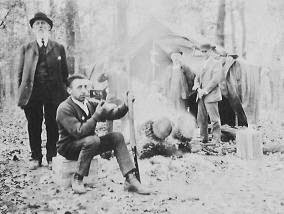
East of Leota was China General Store not far from grandpa’s farm.  He used to send Aunt Bessie (when she was a girl) up there for a five cent plug of tobacco.  China was supplied by a network of local haulers like those in the picture who had camped across the road from the farm.  The picture was taken in 1919 and Grandpa is nearest the tent with the derby hat.  Next to him in the smoke is my father, four years old.  The smoke clouds the photo.  The guy smoking a pipe cradles a long barrel shotgun; there were still wolf packs in those days.  To the right is a wooden margarine box.  Besides Sunkist tobacco, the freighters carried the basics for the stores that even diversified farmers couldn’t get like sugar, coffee, and coal oil.  Galvanized wash tubs were popular.  After the visit they gave grandpa a packet of apple seeds.